
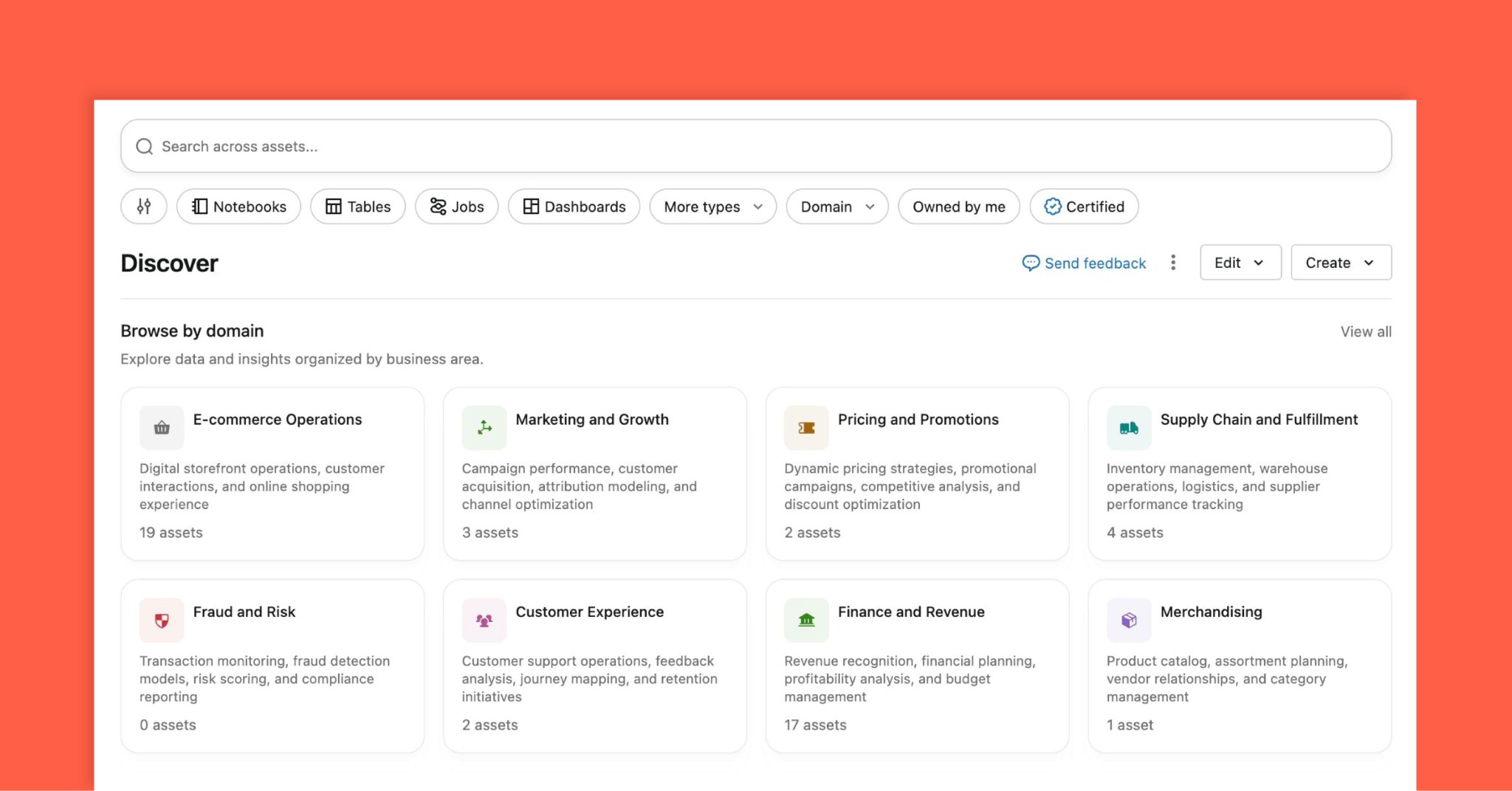
- What: Databricks released "Discover" and "Domains," two new features powered by Unity Catalog.
- Key Function: Organizes data and AI assets into business-aligned categories for easier discovery by humans and AI agents.
- Features: Includes an internal marketplace, AI-powered recommendations, and certified asset tagging.
- Availability: Both features are available in Public Preview starting today within the Databricks workspace.
- Integration: Directly feeds Genie Ontology to provide business context for AI agents.
Databricks has announced the Public Preview of "Discover" and "Domains," a new set of features powered by Unity Catalog designed to help organizations organize and locate relevant data and AI assets. The launch aims to solve the growing complexity of large-scale data estates by allowing businesses to structure assets according to their functional, geographic, or departmental hierarchies. By providing a curated "internal marketplace," the company intends to reduce errors in human reporting and improve the accuracy of AI agents that rely on these assets for grounding.
Solving the 'Data Estate' Complexity Problem
As organizations scale their AI and data initiatives, the volume of assets—including tables, dashboards, and notebooks—often becomes unmanageable. According to Databricks, this growth makes it difficult for both human users and autonomous agents to identify which resources are high-quality, safe, and relevant to a specific task.
The consequences of poor discovery are significant. Databricks notes that without a clear structure, AI agents may ground their answers in incorrect tables, or business users might build reports using outdated metrics. This often leads to redundant work, where teams recreate assets that already exist elsewhere because they were unable to find the original source of truth.
To address this, Domains allow organizations to move beyond technical location-based storage (like schemas and catalogs) and instead organize assets around business structures. This includes mapping assets to functions like Marketing or Sales, business units like Consumer or Enterprise, or geographic regions such as EMEA and AMER.
The Discover Page: An Internal Marketplace
The "Discover" page serves as the human-facing interface for this new organizational structure. Databricks describes it as an internal data and AI marketplace that consolidates various asset types, including:
- Tables and queries
- Dashboards and notebooks
- Metric views
- Genie Agents and custom apps
Instead of navigating complex technical hierarchies, users can browse by business area or search across "certified" assets. The platform includes AI-powered recommendations that suggest high-quality assets based on user activity, popularity, and official certification status. This is intended to eliminate the common workflow of "hunting through schemas" or asking colleagues via chat channels to identify the correct data source.
Governance and Curation for Data Stewards
The update grants new capabilities to data stewards, who are responsible for shaping the discovery experience. Stewards can create subdomains for more granular organization—for example, nesting "Revenue" and "FP&A" under a broader "Finance" domain.
Stewards are also empowered to:
- Certify assets: Provide a clear signal to humans and agents regarding which assets are trusted for production use.
- Annotate domains: Add subtitles, descriptions, and both business and technical contacts to ensure accountability.
- Curate visibility: Build and reorder sections or pin specific valuable assets to the front of a domain page.
By annotating domains with business context, organizations can ensure that every user knows what a specific data set is for and who is responsible for its maintenance.
Building Enterprise Context for AI Agents
A primary objective of the Domains feature is to improve the performance of AI agents. For an agent to deliver reliable outputs, it requires business context—specifically, how an organization defines metrics and which sources are authoritative for certain topics.
Domains extend Unity Catalog Semantics by capturing this organizational structure in business terms. This context feeds into the "Genie Ontology," which Databricks uses to help agents narrow their retrieval to the most relevant domains. For instance, if an agent is asked to forecast revenue, the system can automatically recognize the "Finance" or "Revenue" domains as the primary sources of truth, rather than searching the entire data estate.
This shared foundation allows agents to prioritize trusted assets and interpret results using the specific language of the business, all while respecting the user’s existing permissions and access controls.
Impact on Developers and Users
The introduction of Discover and Domains simplifies the workflow for both data consumers and developers. For developers, the integration with Unity Catalog means that the work done to organize data for human consumption automatically benefits AI agents, making existing agents more reliable and new ones easier to build.
For business users, the "internal marketplace" model reduces "dead ends" in data discovery. By providing a centralized location for certified, popular, and trending assets, Databricks claims that users can land on trusted data without having to track down owners to verify if a table is the "right one."
What’s Next
While Discover and Domains are available in Public Preview today, Databricks announced that a "Glossary" feature is coming soon. The Glossary will allow organizations to add shared definitions for specific terms like "annual recurring revenue" or "bookings," further enhancing the business context available to both humans and AI agents.
Sources
Reader Takeaway: Databricks users can now enable the "Discover" page in their workspaces to start organizing data into business-aligned "Domains." This change moves asset management away from technical silos and toward a business-centric model, which is designed to make AI agents more accurate and data discovery more intuitive for human employees.